Vortex Creative Center · 27 Oct 2026 · PR #8 · live since 03:06 UTC
Our games come from their links, a shot opens at once, and feedback changes the video
You gave the assistant the Diamond Snake link and it never opened it. It named the game from the URL, said there was a gameplay recording when there wasn't one, and set up the video with no game. Now the studio opens the link in its own browser (Browser Use), plays the game, and uses the real thing in videos. The assistant looks at it before it writes a word about the game.
liveBrowser Use harness + Chromevideo-usepreviews 18× smaller76/76 tests
Already done on the live studio: Diamond Snake is in Our games, captured from its link (logo, screens, two real rounds), and your Diamond Snake video's game shot now shows that gameplay.
What you get
A game's link in, the real game out
01Add a game with its linkThe studio opens it the way a phone sees it, on a public page with no login. It reads what the page says, saves the game's own logo file, its first screen and a frame in play, then plays a few rounds and records them. About a minute.
02Videos use the real gameplayThe shots that show the game get the recording as soon as the video is made. A video set up earlier, like your Diamond Snake one, takes one pick: "Our game".
03The assistant looks firstIt reads what the page says and looks at the logo, the screens and a timed grid of the gameplay. Then it writes about the real game, picks the best moment and puts that stretch in the shot.
04browser-use and video-use, installedBoth are on the studio's server and in my own sessions. video-use reads speech with our own Whisper, so it needs no ElevenLabs key.
What it brought back from diamond_snake.vortexgames.bet
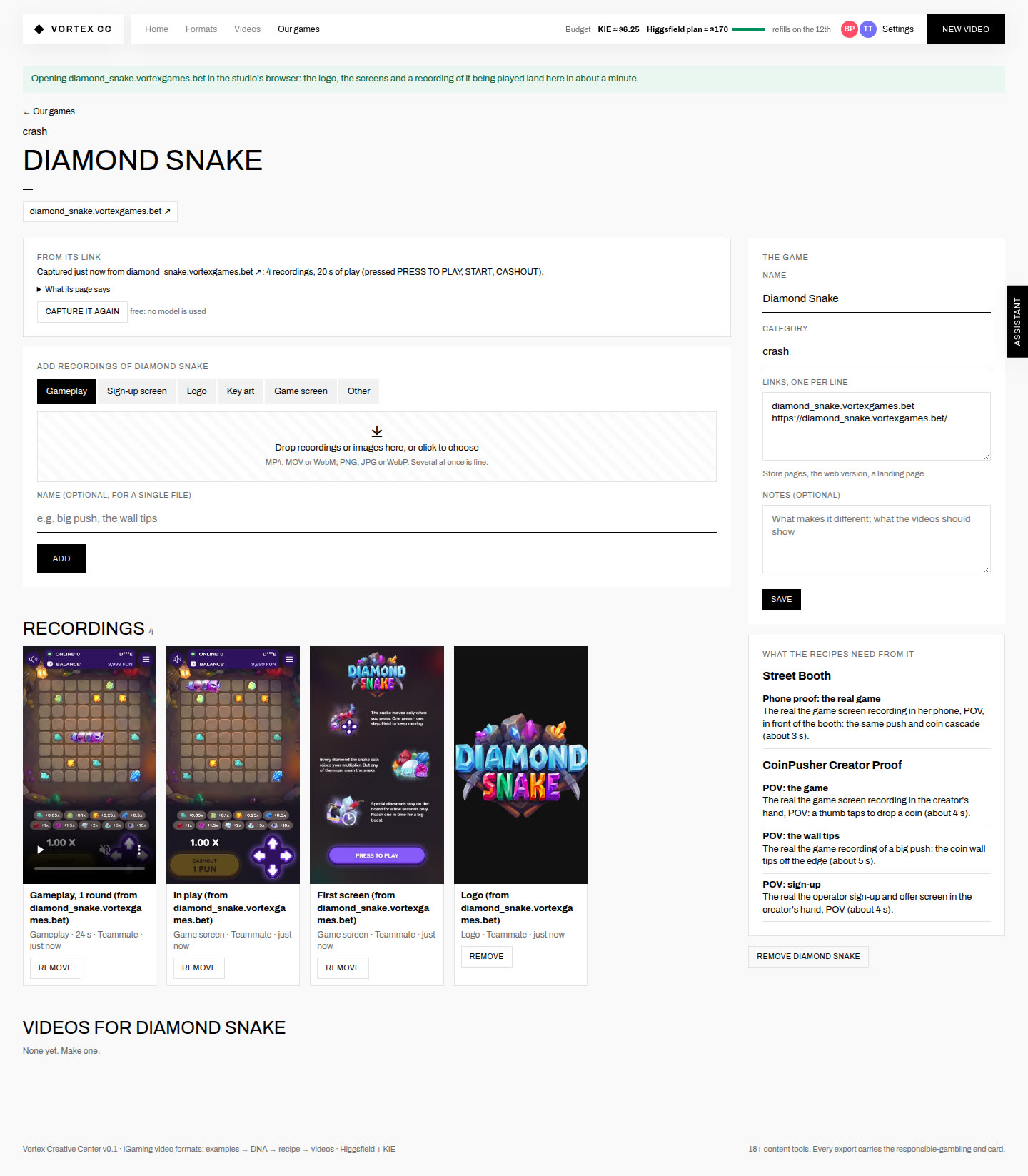
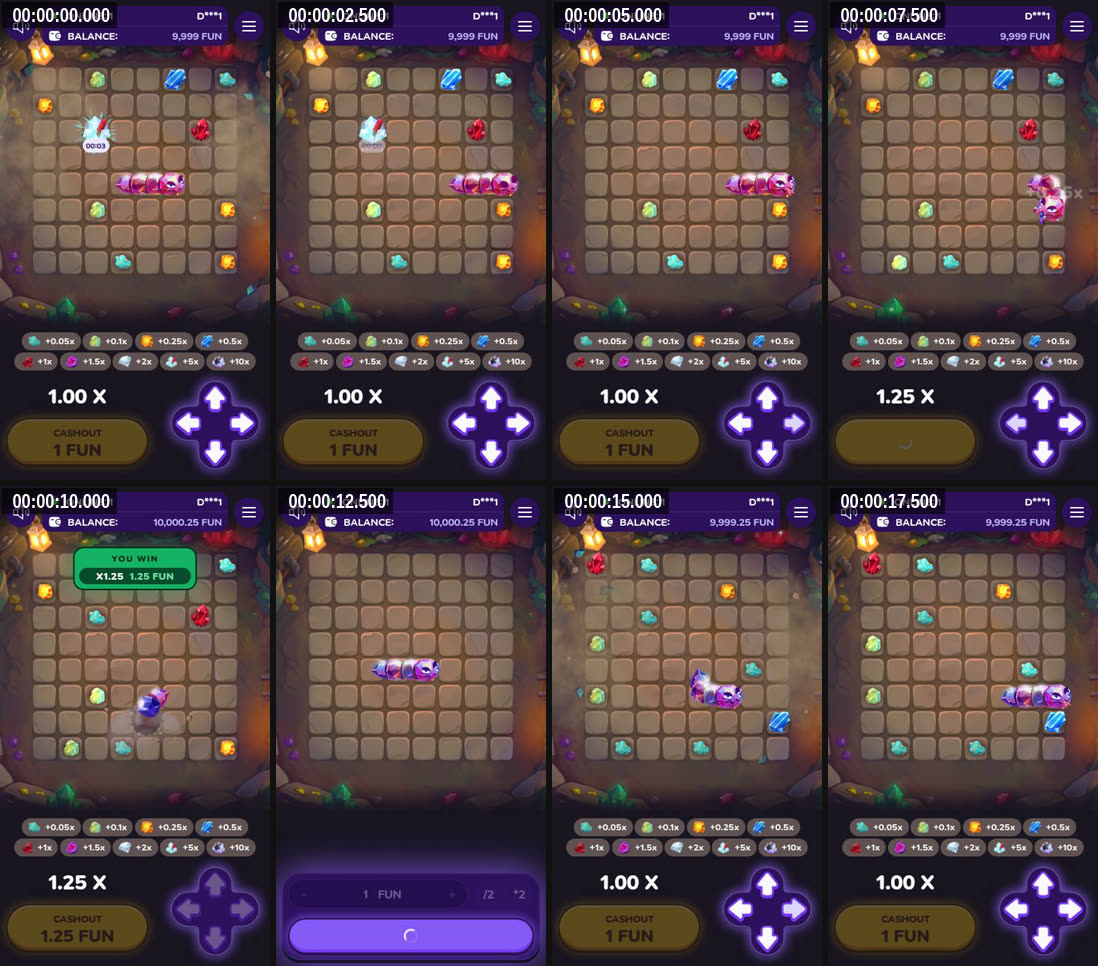
This is a real capture, made by the studio on this branch. The logo is the game's own file. The gameplay is two rounds played by the studio's browser: it ate a gem, reached 1.25×, cashed out "YOU WIN ×1.25", and started again. On the server the whole capture took 82 s.
Our games · Diamond Snakeafter the capture
"From its link": when it was captured, what was pressed, and what its page says. Four recordings: gameplay, in play, first screen, logo.
The gameplay it recorded9 s of 20
Recorded in the studio's browser at 720×1280, with the waiting between rounds left out.
A video for the gamethe shot that shows the game
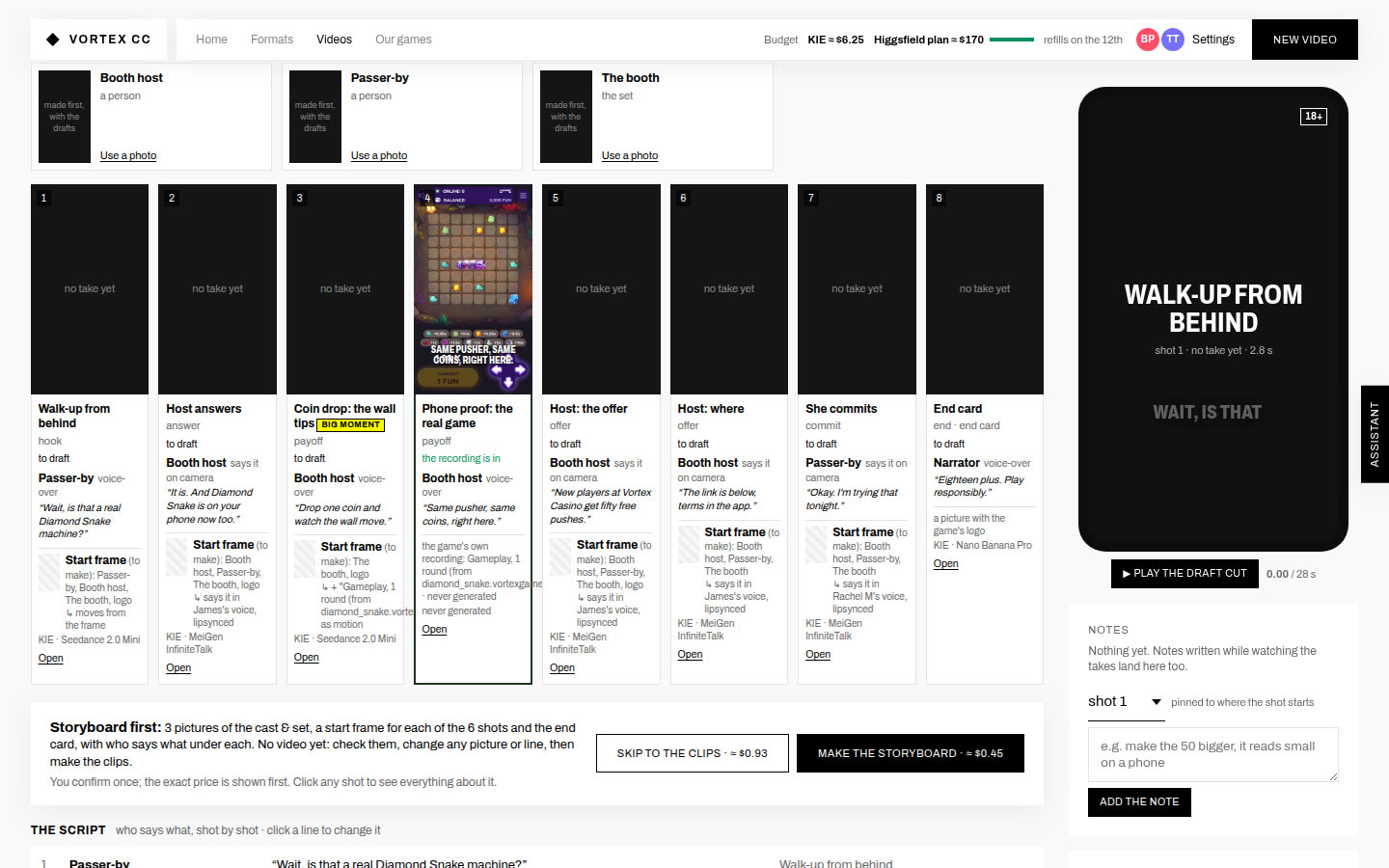
A new Street Booth video for Diamond Snake. Shot 4, "Phone proof: the real game", holds the real gameplay at once ("the recording is in", never generated). Shot 3 uses it as its motion clip.
What the assistant looks atvcc game-strip
Gameplay as a timed grid: it can see the 1.25× win at 0:07–0:10 and put exactly that stretch in the shot (vcc use-clip … --from 6.5 --to 10.5).
Opening a shot was slow. Now it's instant
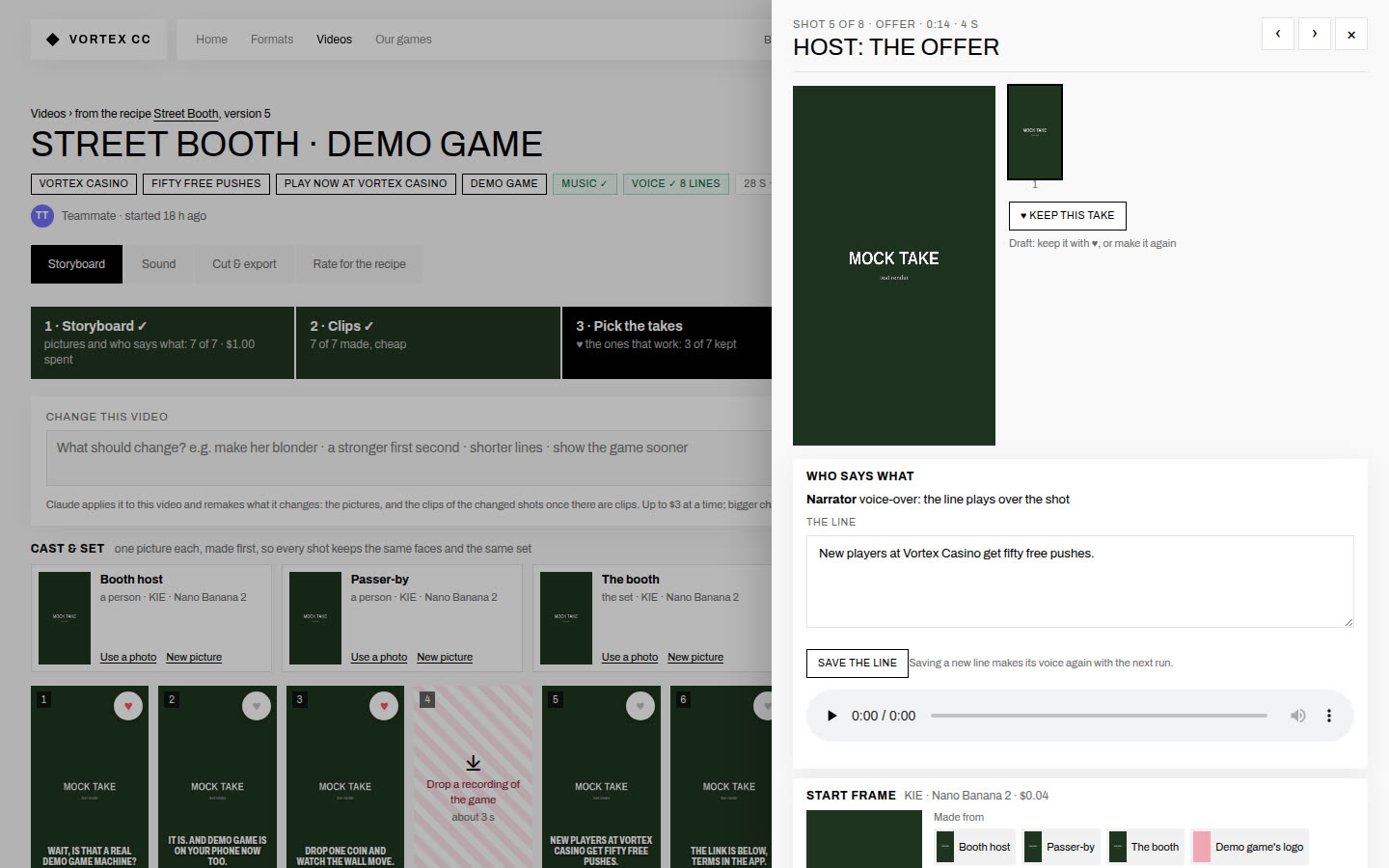
Every card click reloaded the whole page, and the page pulled about 14 MB of start frames: 2 MB PNGs straight from the image model, with caching off, downloaded again on every click and on every live refresh. Now pictures come as small previews (about 110 KB instead of 2 MB), the browser keeps what it has loaded, and a card opens its shot panel in place, in 0.11 s locally. Previous/next, Esc and Back work the same way, and the full picture is one click away.
A card's panel, opened in placeno page reload
A demo video on a local copy (mock pictures). Your videos' previews were already made on the live studio, so the first click is fast too.
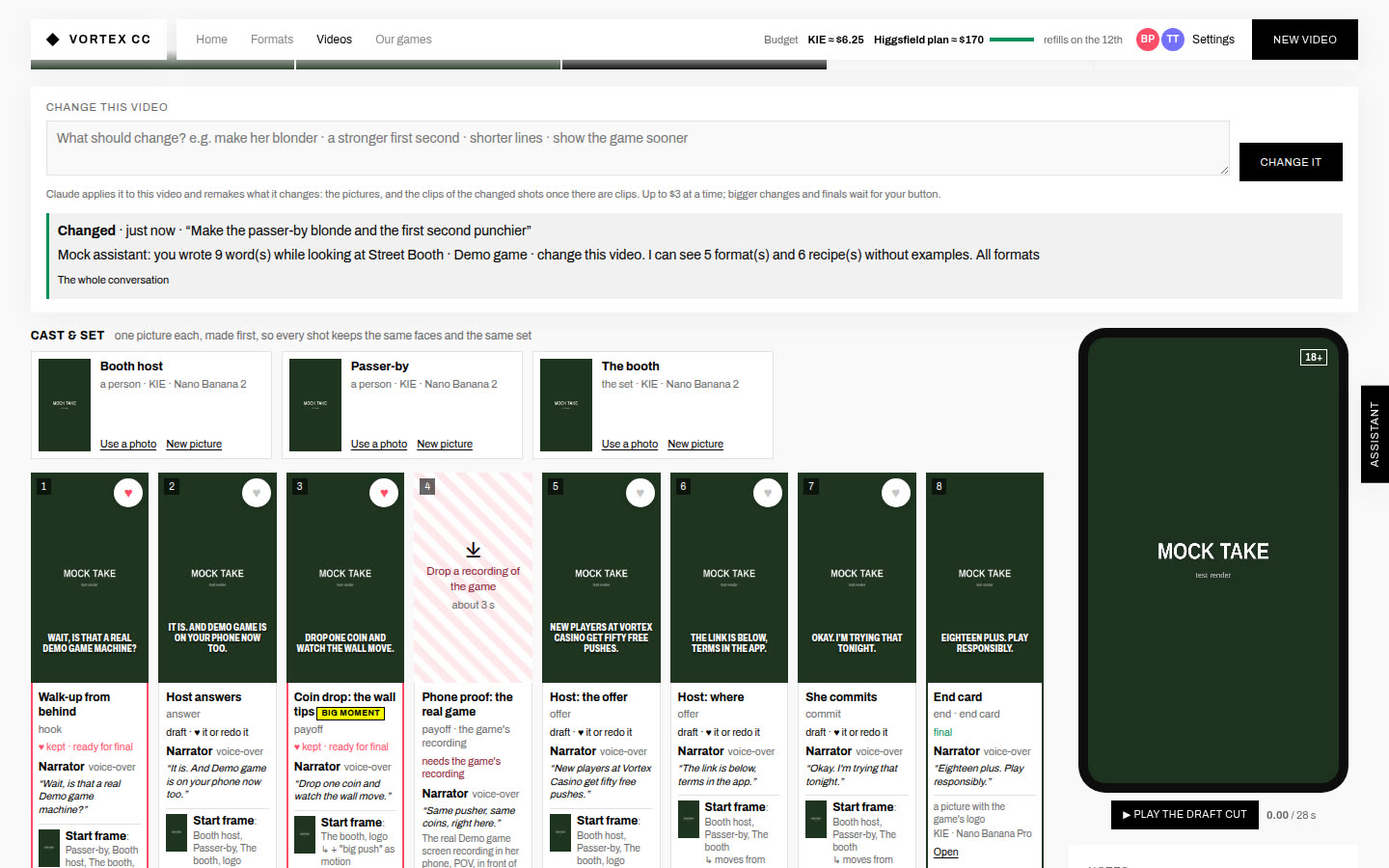
Change this video
A box at the top of every storyboard, and the feedback field on the Videos page. Write what should change, e.g. "make her blonder, a stronger first second". The studio's Claude applies it to this video, and the studio remakes what that changes: the pictures, and once there are clips, the clips of the changed shots (new start frames where those changed, their lines said again). That's up to $3 at a time; anything bigger waits for your Redo button. The box shows the change as it's made, then what Claude says it changed. The note is also kept as feedback on the recipe.
The box, after a changeit updates by itself
On a local copy with the stand-in assistant, so the answer here is a placeholder. On the live studio, Claude makes the edits and the new pictures replace the old ones as they land.
Before → after
Before
After
Your link
Not opened. The name "Diamond Snake" was guessed from the URL.
Opened in the studio's browser. Its title, words, logo, screens and rounds come back in about a minute.
The game's shots
Waited for an upload. The assistant said a recording existed when it didn't.
Filled with the real gameplay as soon as the video is made, or when the capture lands.
Your Diamond Snake video
Set up with no game, so it could never get the game's recordings.
Done on live: linked to Diamond Snake, and its game shot shows the real gameplay.
Opening a shot
A full page reload that pulled about 14 MB of pictures each time.
Opens in place. Small previews (about 110 KB each), kept by the browser.
Feedback on a video
Stored with the video and its recipe; nothing changed.
Claude changes the video, and the pictures and clips it changes are remade, live on the page.
browser-use / video-use
Only on my machine. The studio couldn't use either.
Both installed on the studio's server. video-use reads speech with local Whisper, so it needs no ElevenLabs key.
Worth knowing
The recipes are written for coin pushers. Street Booth's lines say "Drop one coin and watch the wall move", but Diamond Snake is a snake crash game. Now that the page's own words reach the assistant ("Every diamond the snake eats raises your multiplier. But any of them can crash the snake"), it can rewrite the lines for the real game. Ask it to, or we can make a recipe for crash games.
Pages that need a login aren't opened. For those, record the game on a phone and drop the clip on the game's page, as before.
The studio plays like a bot. It sweeps the board with the arrows, taps the middle of canvas games and cashes out after a few seconds. That's good enough to show the game moving and a win; for a hero moment, film a real round.